Emberwhelm sounds like something straight out of Harry Potter. But before you stop reading when you see the AI slop picture below, please hear me out.

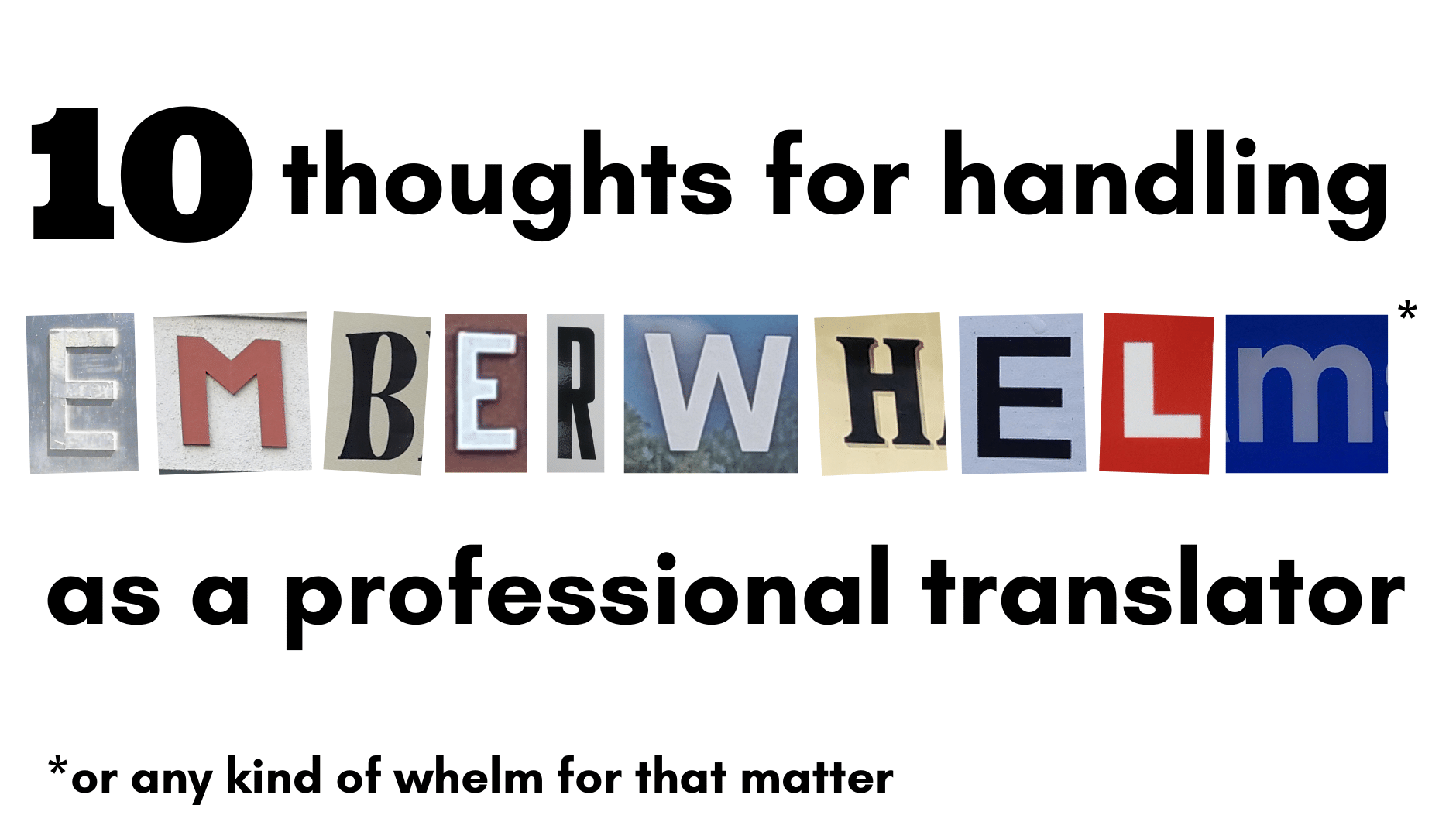
In contrast, the “poison pen” style image accompanying this blog post was not AI-produced. I went through the photojournal that I have kept of daily life in Vienna (featuring hundreds of pictures of adverts, signs, transport and the like) I sought out the ten letters to make up the word “emberwhelm” The pictures date from between 2017 and 2022. It was a curious act of self-care, taking time to sort through photos taken over the years. I have a bigger plan: to curate them into a gallery in Flickr, where in the past I shared photos from my before children (BC) travels. This post is also about self-care to ensure that I am on top form for a busy run-in to Christmas.
So why the ember months?
I have always found the ember monthsThe months of the year ending in -ember (i.e. September to December). Traditionally a very busy time for translators, particularly in jurisdictions with the financial year directly mapping the calendar year. More the most demanding months of the year workwise. I don’t have the seasonal peaks and troughs that many freelancers report. It could be a state of permawhelm: the feeling of work permanently engulfing me. For those who have periods of drought/flood during the year in terms of work, I understand you. Concerns are justified, it is all about filling financial gaps from month-to-month. Staying in business (e.g. paying insurance and social contributions) also costs a not insubstantial amount of money. But what qualifies an in-house translator to highlight issues from their ivory tower? (It’s the town with the lights on in the AI slop image!).
I started writing this on World Mental Health Day (10 October – or 10/10). Suitably 10/10 was about ten thoughts about a ten letter portmanteau word. As the only linguist at my employer, over the last 12 years, I have realised about how to value resilience and having learned how to get through the really overwhelming periods. I have learned that self-care is important to avoid a feeling of permawhelm. Other than the type of employment relationship, my struggles are similar to those of many freelancers. Situations compounded by ailing family members and friends, changes of schools, helping out with my children, and supporting my wife’s jobhunting are all daily concerns.
I’ve been through freelance existential angst (early in my career), and also spent years on medication to continue to function while overworking. I spent a couple of my teenager years on painkillers to get through the day. That made me aware of the dangers of becoming overly dependent on medication. In bad times, I’d often feel panic attacks coming on before flying off somewhere, and would have to make sure I was in my accommodation before taking tablet that could wipe me in minutes and knock me out for hours. In reducing and coming off medication (a lengthy process), I realised that looking after my own wellbeing was key for the future.
So here are my ten thoughts
- Protect your mental health as a high-stakes translator in the age of AI: as an in-demand translator, your mind is your livelihood. You make judgement calls about correct translations. You are held accountable for mistakes. Trite apologies that LLMsA large language model (LLM) is a type of artificial intelligence (AI) algorithm that uses deep learning techniques and massively large data sets to understand, summarize, generate and predict new content. More spit out when they hallucinate don’t work for professional translators. Similarly, AI creates additional pressure on you to work faster, or justifying your relevance against a probabilistic system. This is made worse by LLMs’ deceptive fluency being seemingly good enough for many non-translators. Expert translators cannot compete in terms of output, but can compete and hold their own in terms of outcome.
So how do you protect yourself from the exhaustion that the AI world can cause?
I limit my exposure to AI by turning off AI search results, disabling AI features, and stopping the “dripping news tap of AI news” from pervading into my working environment. This self-preservation method allows me to translate away distraction-free. I use dedicated blocks for deep work (i.e. translating uninterrupted) and take breaks from being online. I change my status to offline or do not disturb on Teams and leave my work phone muted. I journal a lot. I use journalling to come up with ideas for new presentations and to sketch out subject matter areas to cover. Often parliamentary legislative process helps me too. - Stop doomscrolling about the obsolescence of human translators: the “dripping tap of AI news” is compounded by woe from your network from the translation profession. Consider restricting well-meaning updates in safe spaces about colleagues leaving the profession or struggling with poorly paid MTPE jobs. Similarly, able the jobs that stifle the joy and satisfaction that translators derive from their work. The sensationalism from BigTech and BigTransla, as the former desperately try to boost their market values prior to IPOs, has leached into every news source. Stay abreast of developments, but only dedicate a very small block of time to it – maybe using a news aggregation service to do so.
- Narrow your own horizons – focus only on what affects you and your clients, rather than taking a global view: I took the approach of thinking about the subject matter expertise I should expand into rather than following a doom cycle. I’ve tried to focus on subject and target language reading about these areas. Your clients’ needs may be changing, but that doesn’t mean you are automatically no longer part of their plans. If your clients are out there selling physical projects, go to trade fairs and pick up all the information you can glean – particularly from the competition – to understand what the trends are.
- Reconnect with the language: take time to read well in your source and target languages – not just as a hastily purchased Kindle download. Actually visit physical bookshops, engage with the sales staff and regularly find a book based on their recommendations. For escapism, I could read friends’ latest self-published books, but the whole experience of regularly purchasing a book from an independent bookseller is a great way to reconnect with the real world. If you’re a try before you buy type, visit your local library. At the start of the year, I took time to read the German and English translations of a Japanese novel by Michiko Aoyama.1 It was a great feeling to connect with literature. In the GenAI age, reading well from pre-2022 is also a way to read from pre-GenAI texts.
- Recognise the difference between endurance and resilience: there’s a difference between having a stressful week and a permanent state of feeling professionally besieged. Watch out for signs like persistent sleep problems, irritability, difficulty concentrating. Pay even closer attention to inbox dread, loss of enjoyment, or always thinking about work. Don’t automatically interpret these symptoms as evidence that you need to become more disciplined or adapt more quickly to AI. Sometimes the appropriate response is less work, a change in client relationships, more recovery time or professional support.
Persistent distress interfering with everyday life is a sign to speak to a qualified mental health professional. Someone familiar with occupational stress can help you address both emotional and practical pressures. Don’t wait for burnout before asking for help. Resilience should give you room to live, rather than enable you to tolerate more strain. I consciously go down to four day weeks for part of the emberwhelm months, and take the Herbstferien (final week of October) off with the family to make the ember monthsThe months of the year ending in -ember (i.e. September to December). Traditionally a very busy time for translators, particularly in jurisdictions with the financial year directly mapping the calendar year. More more manageable.

Time and space: maintaining clear boundaries
- Use rituals to ensure physical distance from your job: in the height of lockdown, the coach I used, schoolfriend Ian Dinwiddy, ran a podcast called Lockdown Dads. At the time, I felt that I was commuting from bed to home office too much. Work recommended that we took time out during the day (e.g. for that sanctioned walk, that socially distanced chat). Ian’s tip on his podcast was to have a virtual commute. In my case, this was walking around the block from my home. Since the end of the pandemic, it has remained a part of my day when working from home: either walking the children to school or just taking that walk up and down the street. I also used Ian’s coaching to work out strategies for better “bookending” my work day.
As the days get shorter, and the amount of daylight I get is rationed, I make sure I take the time out for a brief walk during the working day, whilst I air my office. If I work from home, my laptop is always fully shutdown – no sleep mode / hibernation. Once it is off, it doesn’t go back on. I use a private laptop for everything else. Similarly, I have always had separate work and private phones (even when I freelanced!) Don’t allow your professional identity to swamp your private identity. I have a group of friends where we refuse to talk about work. Conversation and messaging groups are dominated by our eclectic range of interests. - Availability should be opt-in not opt-out: famine and feast cycles can trap translators. By feeling fortunate to have work, there is also a reluctance to turn it down. You can’t be “always available” in the long term – you need to establish boundaries – working weekends and public holidays need to be compensated for. If work is really urgent, use minimum fees, surcharges and cap the amount of projects you handle concurrently. If you have clients wanting constant availability, develop a response-time policy. Stick to the translation in hand, and clearing that before you turn your attention to the next job. Do not live in fear that a client will ditch you because you can’t work every weekend. Reach a compromise.
- Use tools, but retain control of how you use tools: this is a key principle of the Expert in the Lead approach I coined. The expert professional defines the tools they use and when/how/whether to use them. Professional competence can be demonstrated by outcome, rather than resorting to every tool and trick in the book. Many clients may actually prefer you not to use generative AI/LLMs or NMT for translation. CAT tools with mature termbasesA terminology database – maintained in my case in MultiTerm. More and translation memories can be very effective – after all they are more deterministic, and better suited for the edge cases.
- Find your allies, and view other professionals as allies rather than the competition: you may have niche specialities, and your closest contacts (e.g. fellow translators, contemporaries from university etc.) might not work in your subject matter, but don’t isolate. Find a group (e.g. through a translators association) and create a non-judgmental space to discuss difficult jobs, rates or client expectations. Think of it as a case of “no man is an island“. Ensure that conversations don’t descend into a spiral of doom, and focus on practical information rather than fear. Online communities can be quite pessimistic, so make sure you also have offline connections in small, private groups. One such group from my freelance days existed purely to have a Christmas party and break down isolation.
- Work on promoting what you do best – use the outcomes you deliver to define your value: It could be your particular subject matter and prowess in terms of terminology, your attention to detail. If you’re feeling uncertain of what your strengths are, draw on the successes from your work to date. Craft your strengths and what you really do well into a brief statement and then consider clients who really need and appreciate your abilities. And remember to believe in yourself!
In case you have experienced burnout symptoms, or are recovering from them, why not check out the Where I’m At Community, including its long form podcast.
- Michiko Aoyama, What you are looking for is in the library (translation by Alison Watts) and Michiko Aoyama, Frau Komachi empfiehlt ein Buch (translation by Sabine Mangold). ↩︎
Related posts:

Generating bilingual EUR-LEX web addresses in Python

7 thoughts on Surviving #BigCONFERENCE

Mental Decluttering

7 thoughts: challenges facing translation as a degree course
XITL featured in Translating Europe Forum preview (#2026TEF)

Leave a Reply
You must be logged in to post a comment.